How a 6-Person Agency Doubled Output Without Hiring
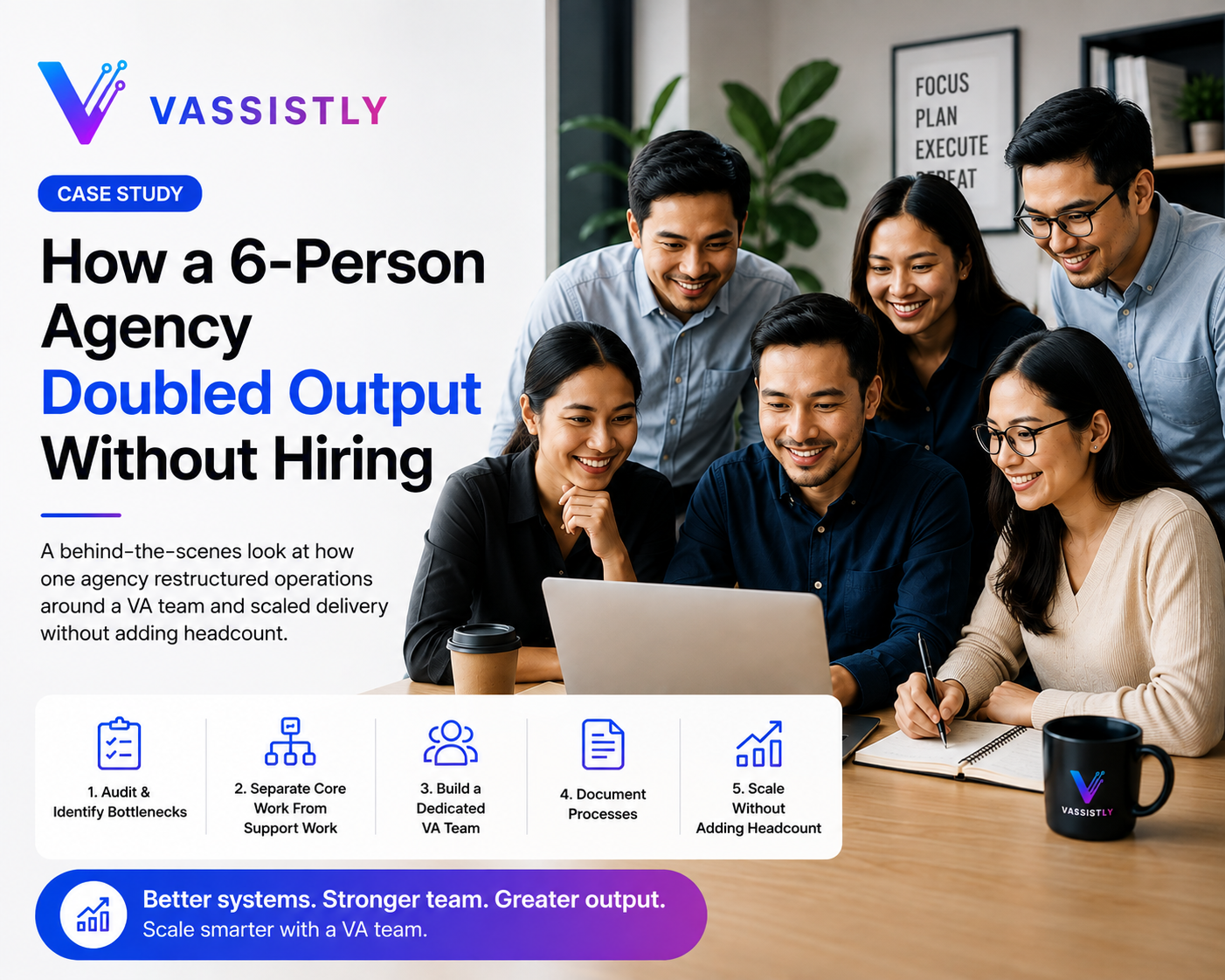
A behind-the-scenes look at how one small agency restructured its operations around a dedicated VA team — and increased delivery capacity without expanding its internal headcount.
They didn't scale by adding more people. They scaled by improving how their existing people were used.
capacity
6-person team
VA layer
in-house
Growth usually creates a familiar problem. More clients mean more work. More work means more pressure on the existing team. And eventually, the business owner reaches a difficult decision: Do we hire more people?
For one six-person agency, that seemed like the obvious next step. The team was already busy. Client requests were increasing, deadlines were getting tighter, and administrative work was taking valuable time away from the people responsible for delivering high-value services.
But instead of immediately adding more full-time employees, the agency took a different approach. They redesigned how work was distributed. The result was a significant increase in output capacity — without increasing their core six-person team.
The Problem Wasn't the Team
The agency had talented people. The problem was that their time wasn't being used efficiently. Team members were spending hours on tasks such as updating spreadsheets, managing inboxes, preparing documents, scheduling meetings, organizing files, following up with clients, and updating project information.
None of these tasks were necessarily difficult. But collectively, they consumed a significant amount of time. And because these responsibilities were mixed into everyone's workload, the team had less capacity for the work that actually generated revenue.
They Audited Where Time Was Going
Before changing their structure, the agency tracked recurring tasks. The goal was simple:
Find out where skilled employees were spending time that didn't require their skill level.
The audit revealed a pattern. A large portion of the team's week was being spent on repetitive, process-driven activities. These tasks needed to be completed — but they didn't necessarily need to be completed by the agency's highest-value employees. That distinction became the foundation of the new operating model.
They Separated High-Value Work From Support Work
The agency divided responsibilities into two categories. They didn't eliminate the second category — they simply stopped expecting their most experienced employees to handle all of it.
Core Work
- Client strategy
- Creative decisions
- Project management
- Client relationships
- Business development
- Quality control
Support Work
- Data entry & research
- Scheduling
- File management
- Administrative updates
- Routine follow-ups
- Report prep & inbox organization
They Built a Dedicated VA Support Layer
Instead of hiring another group of full-time employees, the agency introduced a dedicated virtual assistant team. The VAs were assigned specific recurring responsibilities rather than being treated as general-purpose helpers. Each task had:
A clear owner
One person accountable.
A defined process
Documented steps.
A deadline
Clear timing.
A quality standard
Defined "done."
The goal wasn't simply to "give work to a VA." The goal was to build a system around delegation.
They Documented the Processes
Initially, the team had a common problem: many processes existed only in people's heads. That worked when the agency was small, but it became a bottleneck as the workload increased.
So the agency began documenting recurring processes. Once documented, a task could be delegated without requiring constant explanation.
Client Onboarding SOP
They Introduced a Review System
Delegation doesn't mean abandoning quality control. The agency established a simple review process. VAs handled execution; internal team members handled oversight where necessary.
Completes the process.
Reviews important outputs.
Focuses on decisions and growth.
As the VAs became more familiar with the business, the amount of supervision required decreased.
The Results
The biggest change wasn't simply that more tasks were completed. The internal team had more capacity. Instead of spending hours on administrative work, employees could focus on serving clients, completing specialized work, improving processes, taking on additional projects, developing new business, and solving higher-level problems.
The agency effectively increased its delivery capacity without proportionally increasing its internal headcount. In other words: they didn't scale by simply adding more people. They scaled by improving how their existing people were used.
What Actually Doubled Output?
It wasn't one magic tool. It wasn't simply hiring VAs. And it wasn't asking the team to work longer hours. The real change came from restructuring the workflow.
Before
Client Work + Admin + Follow-Ups + Data + Scheduling → Internal Team
After
Client Work + Strategy → Internal Team
Administrative & Repetitive Work → VA Team
This allowed the agency to create more output from the same core team.
The Lesson for Growing Businesses
Many businesses assume that growth requires proportional hiring. If workload doubles, they assume their workforce needs to double too. But that's not always true. Before hiring another full-time employee, ask: "Is this additional work actually specialized work?" If the answer is no, there may be an opportunity to delegate it.
You don't need to build a large VA team immediately. Start with one recurring area:
Administrative VA
Scheduling, data entry, documents, coordination.
Customer Support VA
Inquiries, follow-ups, ticket management.
Operations VA
Systems, reports, workflows, documentation.
Executive VA
Calendar, inbox, research, admin support.
Once the first role is working effectively, additional responsibilities can be delegated gradually.
You May Not Need a Bigger Team
The six-person agency didn't discover a way to make its employees work twice as hard. It discovered how to make each person's time more valuable. Sustainable growth isn't about squeezing more hours out of your team — it's about creating a structure where everyone spends more time doing the work they're best equipped to do.
VAssistly helps businesses build dedicated virtual support teams that integrate into existing workflows — so companies can increase capacity without automatically increasing internal headcount.
Build your VA support layer →