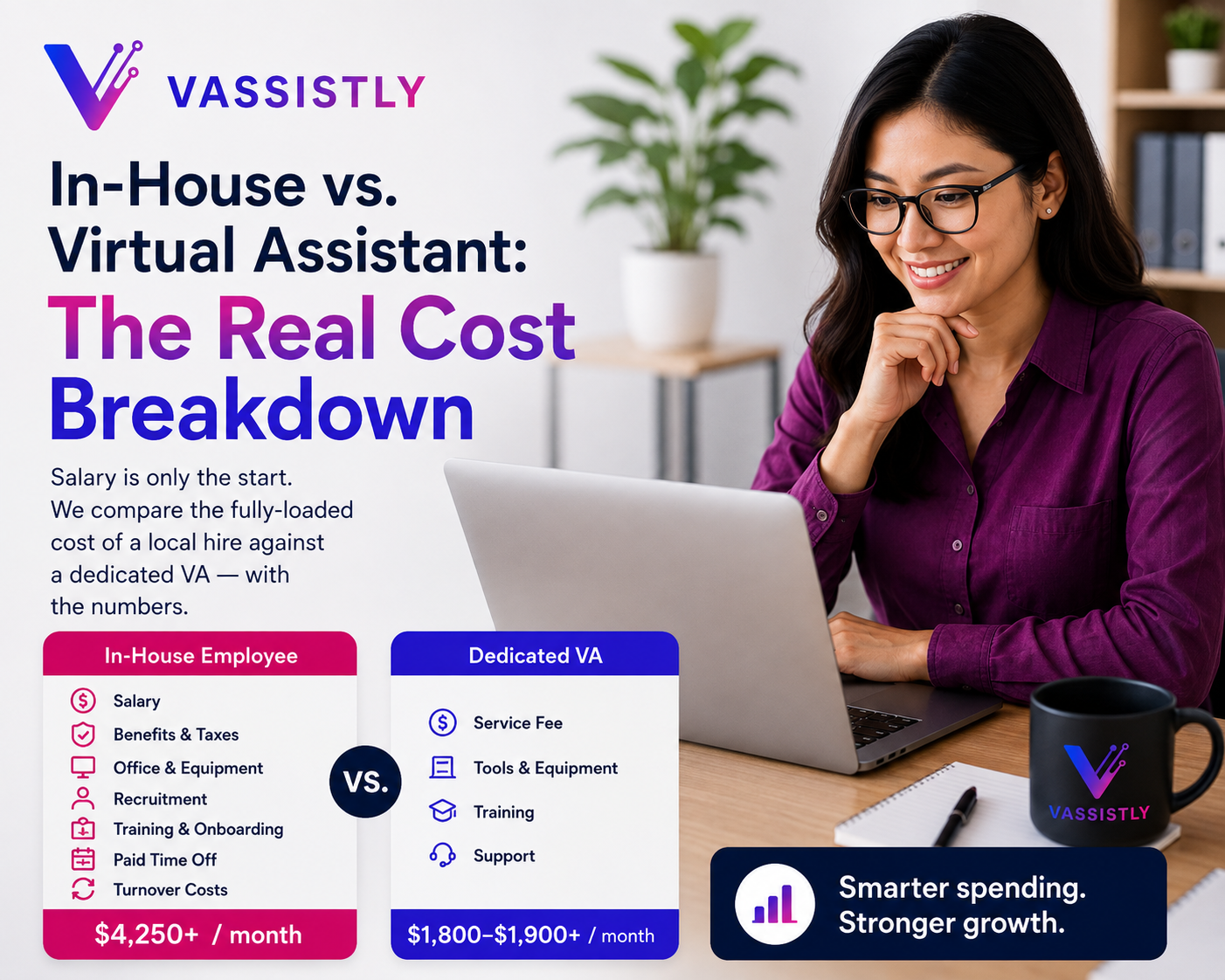
In-House vs. Virtual Assistant: The Real Cost Breakdown
Salary is only the beginning. When comparing an in-house employee with a dedicated virtual assistant, the real question is: how much does each option actually cost your business?
The real cost of an employee includes much more than their salary.
cost of a hire
comparison
own time
costs
Hiring help is a major decision for any growing business. When you need someone to handle administration, customer support, scheduling, data entry, follow-ups, or other recurring tasks, the traditional choice has usually been to hire someone locally. But there's another option: working with a dedicated virtual assistant.
At first glance, comparing the two can seem simple. Look at the employee's salary, compare it with the VA's rate, and choose the cheaper option. But that's not the full picture.
Start With the Salary
Let's use a simple example. Suppose you're considering hiring a full-time administrative employee for $3,500 per month. That sounds like the cost of the hire.
It isn't.
Once you account for the additional costs associated with employing someone, the actual monthly expense can be considerably higher. A virtual assistant, on the other hand, may operate under a much simpler cost structure. That's why comparing salary against a VA's monthly fee can produce a misleading conclusion.
The Hidden Costs of an In-House Hire
Here are some of the costs business owners need to consider.
Your employee receives a regular salary regardless of whether their workload fluctuates throughout the month.
Employer taxes, social security, health insurance, retirement contributions, paid vacation, sick leave, and other benefits can add significantly to the base salary.
Office space, desk and chair, computer equipment, internet, utilities, and supplies. Adding employees increases your operating costs.
Job advertisements, recruitment platforms, recruiting services, interview time, background checks — and, more importantly, your time.
A new employee doesn't become productive on day one. Someone must train them — time your existing team spends onboarding instead of on their own work.
If your employee leaves, you start again. Recruitment, interviews, onboarding, training, and the productivity gap all have a cost.
What Does a Dedicated VA Cost?
A dedicated virtual assistant generally has a different cost structure. Instead of taking on the full overhead of a traditional employee, you typically pay for the service or agreed working arrangement.
And because the VA works remotely, your business can access talent without limiting the search to people who live near your office.
Generally no need to provide
A Simple Cost Comparison
Let's look at an illustrative example.
| Cost Category | In-House Employee | Dedicated VA |
|---|---|---|
| Base compensation | $3,500 | $1,800 |
| Employer costs & benefits | $500+ | Included / varies |
| Office & equipment | $250+ | $0–$100 |
| Recruitment | Variable | Usually lower |
| Training & onboarding | Higher | Varies |
| Paid time off | Additional cost | Depends on arrangement |
| Replacement / turnover | Potentially significant | Depends on provider |
| Estimated monthly cost | $4,250+ | $1,800–$1,900+ |
These figures are illustrative only. Actual costs vary significantly by country, role, experience level, benefits, provider, and employment arrangement.
The point isn't that every VA costs exactly $1,800 or every employee costs $4,250. The point is that the comparison needs to include the entire cost of the hiring model — not just the advertised salary or hourly rate.
But Cost Isn't Everything
Choosing a VA simply because they're cheaper would be a mistake. The more important question is: what value are you getting for the money you spend?
The right person doesn't simply complete individual tasks. They can become an extension of your team.
A good VA can own
The Productivity Factor
There's another cost that is easy to overlook: your own time.
Imagine a business owner spending 10 hours every week managing administrative tasks. That's approximately 40 hours per month. If those hours could instead be spent on sales, partnerships, strategy, client relationships, or business development, the financial impact of delegation could be much greater than the VA's monthly cost.
"How much is my time worth, and what could I accomplish if I stopped doing these tasks myself?"
When Each Option Makes Sense
An in-house hire
- The role requires frequent physical presence
- Access to physical equipment or facilities
- Face-to-face customer interaction
- Close in-person collaboration
- Specific regulatory or operational requirements
A dedicated VA
- Administrative work & customer service
- Scheduling & data management
- Online research & email management
- Follow-ups & back-office operations
- Routine, computer-based business processes
A VA is especially useful for growing businesses that need additional capacity but aren't ready to take on the full overhead of another local employee.
Don't Compare People. Compare Business Models.
The biggest mistake in this decision is comparing employee salary vs. VA rate. Instead, compare total employment cost vs. total outsourced cost. Then consider the productivity gained, the flexibility available, the management requirements, and the type of work being performed.
A $3,500 employee isn't necessarily expensive if they generate significantly more value than they cost. And a $1,800 VA isn't necessarily a bargain if the work isn't completed reliably.
The goal isn't to find the cheapest option. The goal is to find the most efficient way to get the work done well.
The Bottom Line
For administrative and remote-friendly roles, a dedicated virtual assistant can be a compelling alternative — particularly when you factor in the hidden costs of traditional employment. Before your next hire, calculate the true cost: benefits, recruitment, equipment, office space, training, turnover, management time, and productivity.
VAssistly helps businesses build dedicated virtual support teams so owners can reduce administrative workload, control operating costs, and focus on growth.
Calculate your true cost →